
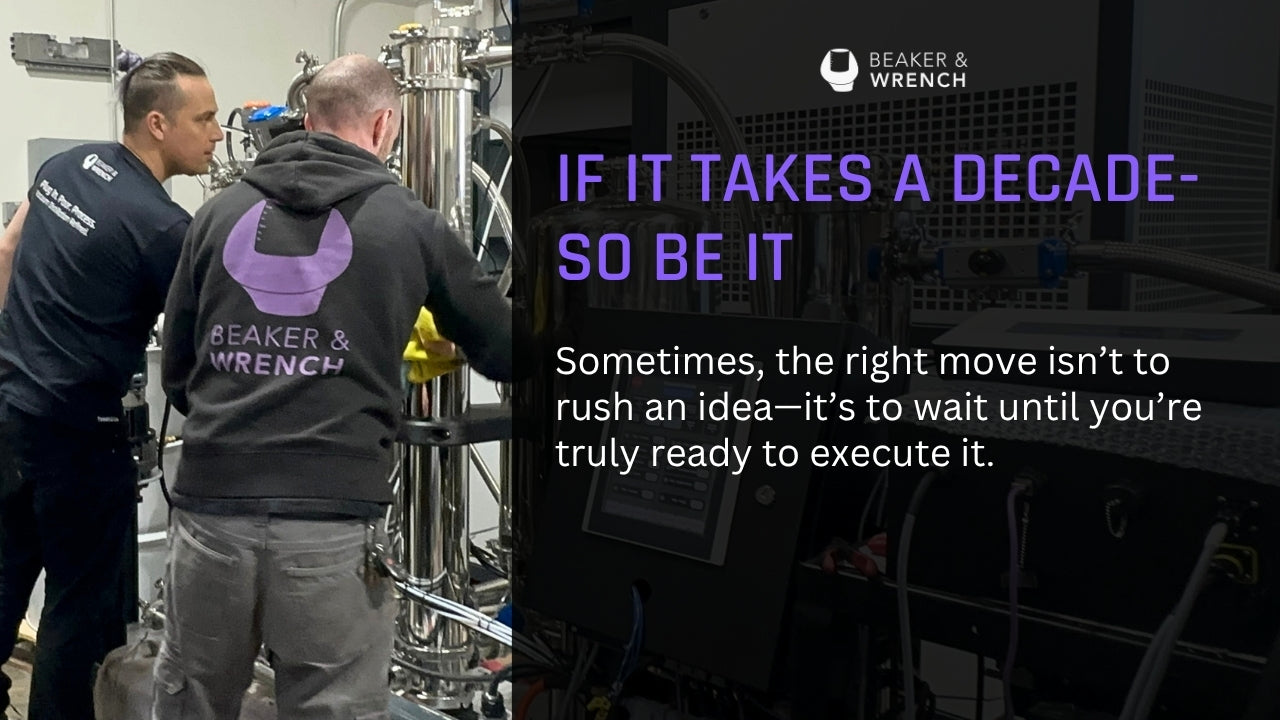
It took me nearly a decade to build the BW-ACFS60.
Sometimes, the right move isn’t to rush an idea—it’s to wait until you’re truly ready to execute it. When I first considered adding an extraction system to our lineup, I knew I didn’t have the understanding to do it the way I wanted to.
So I waited and decided to focus on building experience, refining our process, and strengthening our foundation.
From the beginning, it was important to me that whatever we created would be competitive—and more importantly, meaningful. I wasn’t interested in putting another version of the same equipment into a market where reliability was already a concern.
The goal was never to reinvent the wheel.
It was to build something better—something that adds real value.
Building the Foundation
What do I mean by building “the foundation”?
It started with developing a deeper understanding of both the extraction process and the systems already on the market. I needed to clearly identify where we could bring real value to our clients.
As I spent more time learning the process, one thing stood out: extraction was still heavily manual. It required constant valve changes and hands-on monitoring just to keep things running smoothly.
That was something I knew I wanted to change.
The answer was simple, the extraction system I built needed to be automated.
At the time, I had no direct experience in automation. But I found an opportunity to challenge myself while building the BW-SR50. Working alongside our Principal Engineer, Robert, we set out to design a fully automated solvent recovery system.
It wasn’t straightforward. It took months and years of trial and error to get the automation to perform the way we envisioned. But once we achieved a fully automated solvent recovery system, it shifted what felt possible.
An automated extraction solution was no longer just an idea—it became realistic.
"From the beginning, it was important to me that whatever we created would be competitive—and more importantly, meaningful."
Putting the Pieces Together
When it came time to build the BW-ACFS60, I knew that choosing the right partners would be critical.
There were four key components to consider: the centrifuge, the chilling system, the filtration setup, and the automation tying it all together.
The Centrifuge & The Chiller
For the chiller, the choice was clear. Huber had already proven to be a reliable partner over the years. We’ve used their systems across multiple units, including the BW-6WFE, so there was already a level of trust and performance we could depend on.
The centrifuge, on the other hand, required more consideration.
While it may seem like a standard piece of equipment, it needed to do more than just function—it had to communicate seamlessly with our system. Integration was critical.
We needed a partner that would be willing to collaborate, allowing our automation to fully interface with their machine.
That led us to Western States. With over 100 years of experience manufacturing centrifuges, they brought both reliability and a willingness to work with us on system integration. Their 15 lb centrifuge fit naturally into our process and met the level of control we were aiming for.
With the centrifuge and chiller in place, the next challenge was solving how to handle pre-chilling, heating, and filtration within a fully automated workflow.
Pre-Chilling, Chilling & Filtration
Now that the first two components were in place, the next step was figuring out how to bring the entire system to life.
The solution was to integrate pre-chilling, chilling, and filtration onto a single skid. By consolidating everything into one platform, we were able to create a compact, fully automated system.
This approach eliminated the need for constant valve changes and hands-on monitoring. What was once a manual, fragmented process became a contained, streamlined operation.
A true one-button solution.
The collaboration played a big role in making that possible. With a Principal Engineer who specializes in automation, and my background in thermodynamics, we were able to approach the system from both sides and meet in the middle.
That’s how the pieces came together.
Looking Back on the Build
Now that the BW-ACFS60 is complete, I find myself looking back on the journey.
If there’s any advice I can offer to someone feeling frustrated with their progress on a project, it’s this: be patient, never stop learning, and keep moving forward—no matter how small the steps feel.
Spending nearly a decade thinking about and working toward an extraction system might seem like a long time. But that time was going to pass regardless—and now, I have the system I envisioned all those years ago.
Consistent effort, even in small increments, adds up more than you think.

Leave a comment
All comments are moderated before being published.
This site is protected by hCaptcha and the hCaptcha Privacy Policy and Terms of Service apply.