
Wiped Film Distillation: The Smart Investment
When purchasing a wiped film distillation system, many buyers focus heavily on upfront cost. A lower-priced system can seem like the smarter financial decision, but in reality, cheap equipment often comes with hidden costs that quickly outweigh the initial savings.
Downtime, repairs, vacuum leaks, difficult assembly, and poor performance can drain both time and revenue. A well-built wiped film distillation system may cost more upfront, but over time it often becomes the more economical option through reliability, higher throughput, easier operation, and immediate operational readiness.
The true value of a wiped film system goes far beyond the purchase price.
The True Cost of Cheap Systems
For processors producing high-value distillate, even a single day offline can represent thousands of dollars in lost production. If a system produces two liters an hour and the distillate is worth $1,000 per liter, that can mean roughly $8,000 in lost revenue per shift and over $40,000 in a single week.
A few days of downtime can easily exceed the price difference between a cheap system and a premium one.
These costs often begin before production even starts. It is a common experience for operators to spend weeks or even months troubleshooting used or foreign wiped films before they can achieve stable operation. Poor assembly, vacuum leaks, incompatible components, and lack of support can delay production far longer than expected.
Processors benefit more from systems that are integrated, tested, and designed to run quickly after delivery.
The Beaker & Wrench wiped film systems are manufactured to operate just hours after arrival. That helps operators avoid long startup delays and focus on production instead of troubleshooting.
Reliability Matters More Than Most People Realize
The costs of operating a wiped film distillation system do not stop after startup. Maintenance, troubleshooting, and repairs are ongoing operational costs that can quickly add up or even cripple production if replacement parts or technical support are difficult to obtain.
A wiped film distillation system should be designed for long-term operation, not constant maintenance.
Some of the most common mechanical issues involve vacuum leaks, poor flow path design, weak pumps, and underperforming circulators. These problems directly affect vacuum depth, efficiency, throughput, and consistency.
To help avoid these issues, Beaker & Wrench uses high-quality pumps paired with Huber circulators for strong thermal performance and system stability. Components are also stocked domestically so replacement parts can be shipped quickly if needed.
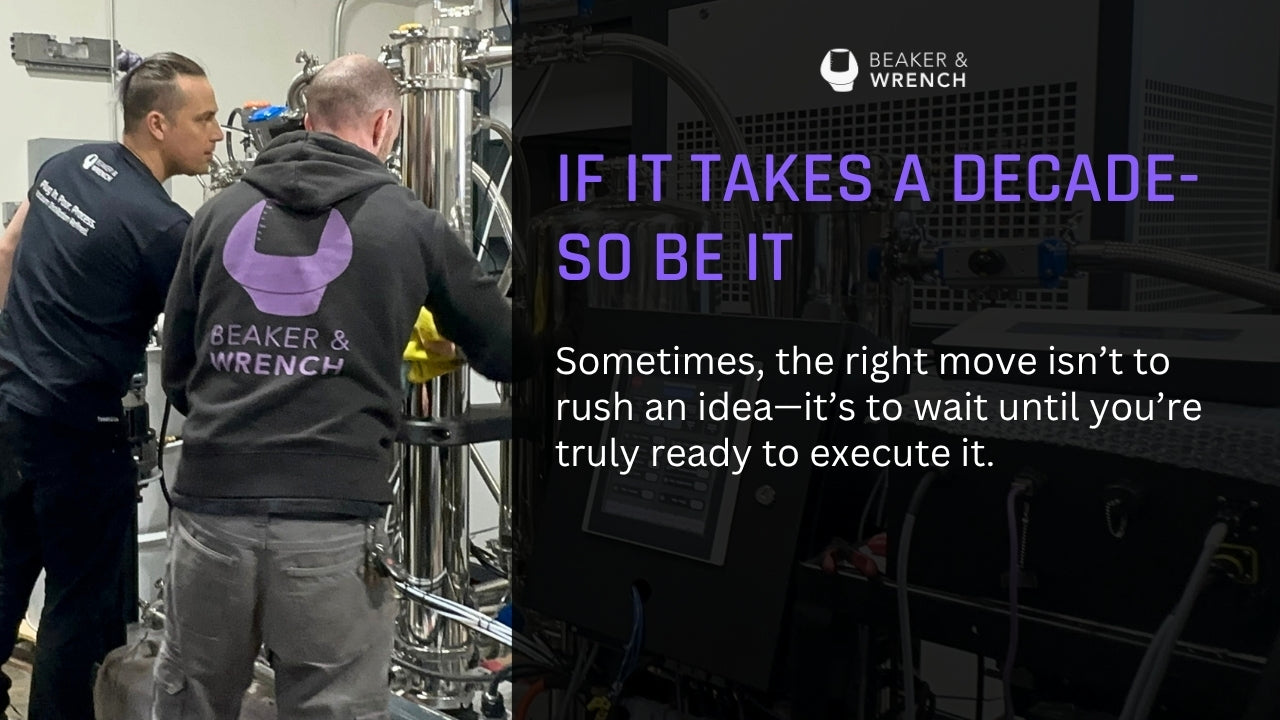
Over the last decade, Beaker & Wrench has focused heavily on vacuum performance by optimizing flow paths, refining assemblies, and engineering every component to be as vacuum tight and maintenance-free as possible.
Even many older Beaker & Wrench systems regularly achieve vacuum depths that other “high-end” systems struggle to reach.
A cheaper machine may look attractive initially, but those savings can disappear quickly once troubleshooting, repairs, production delays, and maintenance begin affecting day-to-day operations.
Comparing Apples to Apples: Size and Throughput
One of the biggest mistakes buyers make while comparing wiped film systems is misunderstanding actual evaporator size and throughput capacity.
Lower-cost systems are often missing important components such as feed pumps, discharge pumps, heated flow paths, immersion chillers, or properly sized high-vacuum pumps. But beyond missing features, buyers also frequently overlook one of the most important performance factors of all: evaporator surface area.
Wiped film throughput scales directly with the evaporator area.
One of the clearest examples is comparing a BW-6WFE to systems like the KD-10 or VKL-75. While they may appear similarly priced, they are not similarly productive.
A KD-10 has roughly 0.10m² of evaporator area.
A VKL-75 has roughly 0.05m².
The BW-6WFE has approximately 0.25m².
That difference in evaporator size is a major reason why the BW-6WFE can process material roughly 2x to 5x faster depending on the application.
When buyers compare systems based on real throughput capacity and operational capability rather than upfront price alone, the long-term economic value becomes much clearer.
Serviceability and Support
Reliable systems reduce unexpected shutdowns, maintain consistent performance, and stay productive for years. Just as importantly, they should also be easy to service when maintenance is required.
The Beaker & Wrench wiped film systems were designed with both reliability and repairability in mind. Components are accessible, systems are engineered for real-world operation, and maintenance can be performed without excessive downtime.
That combination of reliability and serviceability directly impacts profitability by helping operators keep systems online and production moving.
The value of a wiped film distillation system also goes beyond the hardware itself.
Strong customer support can make a major difference when questions or issues arise. Having direct access to experienced engineers and technicians helps minimize downtime and keeps operations running smoothly.
The Beaker & Wrench team works closely with customers throughout installation, startup, and operation to help ensure a smooth experience from beginning to end.
With many lower-cost imported systems, support can be extremely limited or nonexistent. When problems occur, operators are often left diagnosing issues on their own, leading to additional delays and lost production.
Reliable support is part of what makes a premium system worth the investment.
Why Beaker & Wrench Systems Deliver Strong Long-Term Value
Beaker & Wrench systems were designed to offer a balance of performance, reliability, and cost efficiency.
As Ace Shelander, Founder, CEO, and Head Engineer at Beaker & Wrench explains:
“I designed the system to be in the middle of the road, right, where you’re at the knee of the exponential cost.”
The goal was never to create the cheapest system on the market. The goal was to build a fully featured, highly reliable wiped film distillation system that delivers real long-term value.
Customers receive high throughput, dependable performance, strong support, and immediate operational readiness without paying inflated pricing for diminishing returns.
When compared accurately against similarly capable systems, the value proposition becomes much clearer.
Conclusion: A Smarter Long-Term Investment
Choosing a wiped film distillation system is about more than upfront cost. Reliability, throughput, ease of operation, serviceability, support, and long-term operational efficiency all play a major role in profitability.
While cheaper systems may appear attractive initially, they often create hidden costs that far exceed the original savings.
A properly engineered wiped film distillation system delivers value through uptime, consistent production, faster startup, and dependable long-term performance.
The next time you evaluate a wiped film system, consider the full picture rather than just the purchase price alone.
Beaker & Wrench wiped film distillation systems are built to help processors stay productive, minimize downtime, and maximize the long-term value of their investment.

Leave a comment
All comments are moderated before being published.
This site is protected by hCaptcha and the hCaptcha Privacy Policy and Terms of Service apply.