
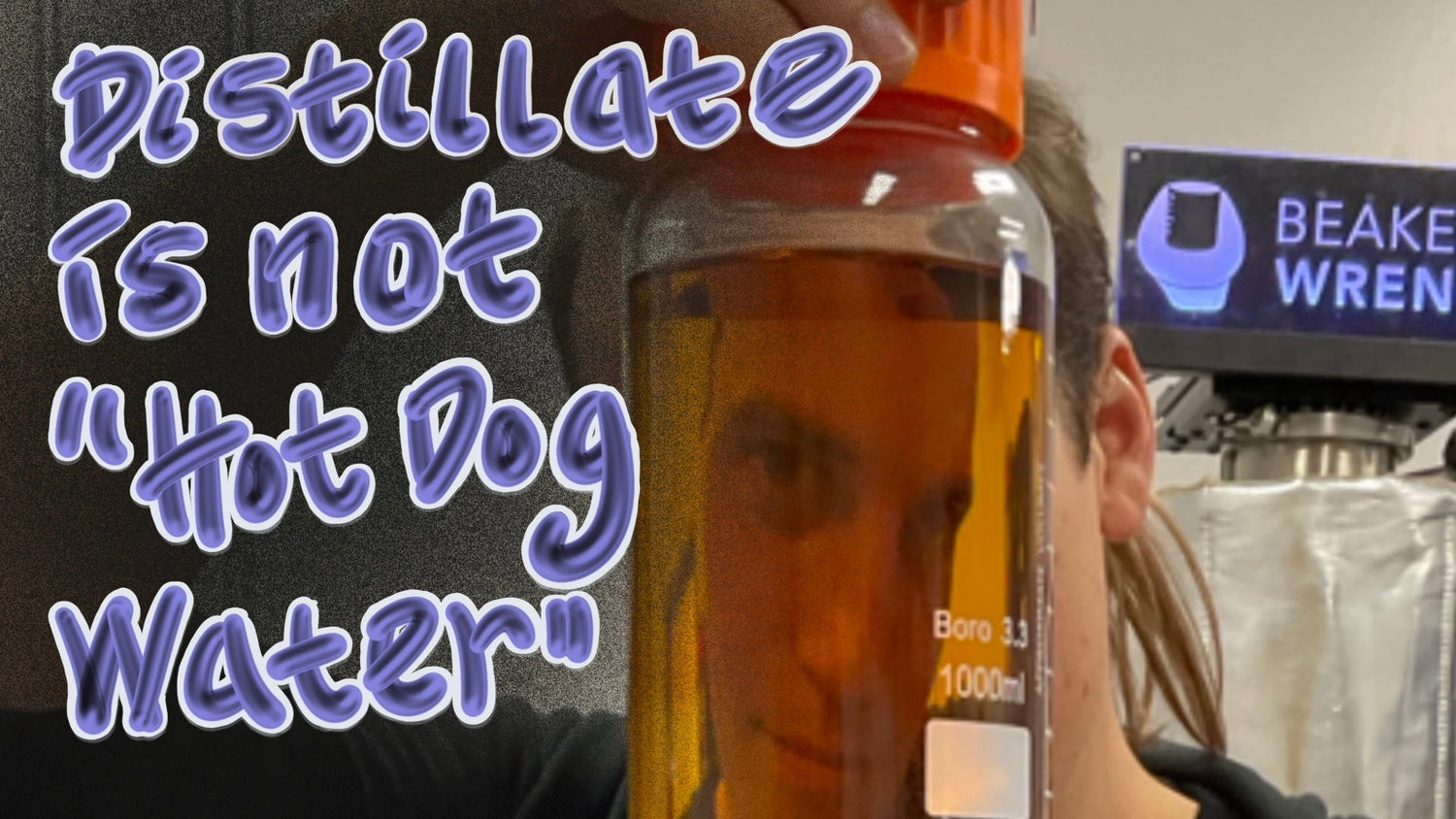
You are likely familiar with the comparison of THC distillate to “hot dog water”. It has been going around the industry since at least 2019. THC distillate is one of the purest THC products available, frequently achieving 99% cannabinoid content. Still, the comparison may have been made for a couple of reasons, which I will explain in detail. I’ve also included one tip to take your distillate to the next level and make sure it’s never called “hot dog water” again.
The first comparison is based on the fact that distillate is usually made from plant scraps; the trimmings and buds that could not be sold by themselves. Unlike hot dogs that are actual meat scraps bonded together with meat glue (yes, it's a real thing), distillation is a process that separates high-value material from the feedstock. For example, Grey Goose vodka is 40% ethanol distilled from a wet mash of fungus-infested grains; THC Distillate is 99% cannabinoids distilled from an extract. The difference between top shelf and gut rot is execution, not the process itself; execution always matters. Side note: I always reference “total cannabinoids” as this is a better measure of how good your process is, since distillation cannot efficiently separate different cannabinoids, and I dislike the industry's obsession with THC potency while ignoring all the other cannabinoids.
Let's dig into that execution a little further and look at how “hot dog water” is made. Distillation can separate solvents, terpenes, and cannabinoids from the plant's tars that are present in the extract. The process is so efficient that even the laziest operator can strip solvent to non-detect. Light and medium terpenes are also easy to remove, representing most of the flavor/aroma. However, to achieve a truly flavorless product requires the separation of heavy terpenes. These heavier terpene compounds are similar in boiling point to Cannabinoids and make up only ~1% of the product, but leave a subtle flavor I usually describe as “burnt rubber”; others might describe it as “wet hotdog” or “hot dog water”. Removing the heavy terpenes is frequently skipped since a 90% THC specification can usually be achieved even with this 1-2% impurity. This small amount of impurity has a large effect on quality perception, especially in vapes, where the smell/taste is very noticeable, leading to the “hot dog water” comparison.
Here’s my tip to fix the taste issue, which is actually quite easy: do a better terpene strip. A dedicated pass can help in challenging circumstances, but a properly tuned stripping pass is usually sufficient. The operator must take a deep enough terpene cut that a few cannabinoids are starting to distill. Turning up the evaporator temperature until there is a small but measurable amount of cannabinoids distilling is the simplest surefire way to do a good terpene strip. I usually target 10-20% cannabinoid content in the distilled terpenes. This can be measured with HPLC, Mass spec, or using the “sticky test” (taking a drop of the terpenes between your fingers and feeling for an “oily” texture or “first string”). Because the loss is at most 20% of 5%, the loss of yield is very small, less than 1% of the total yield. This small modification can make the difference between having a neutral, smooth top shelf product and a product that tastes like “hot dog water.”
So now you know “hot dog water” was never a fair label for the distillation as a process — it’s a label for bad distillate with poor execution; and now you know how to make sure your product never gets that label. Check back in a couple of weeks for a dive into color and its effects on purity, quality perception, and a tip on how to achieve the best color.

Leave a comment
All comments are moderated before being published.
This site is protected by hCaptcha and the hCaptcha Privacy Policy and Terms of Service apply.